Designing the GenAI Help Learners Receive
Which choices in AI assistance help students develop understanding and judgment?
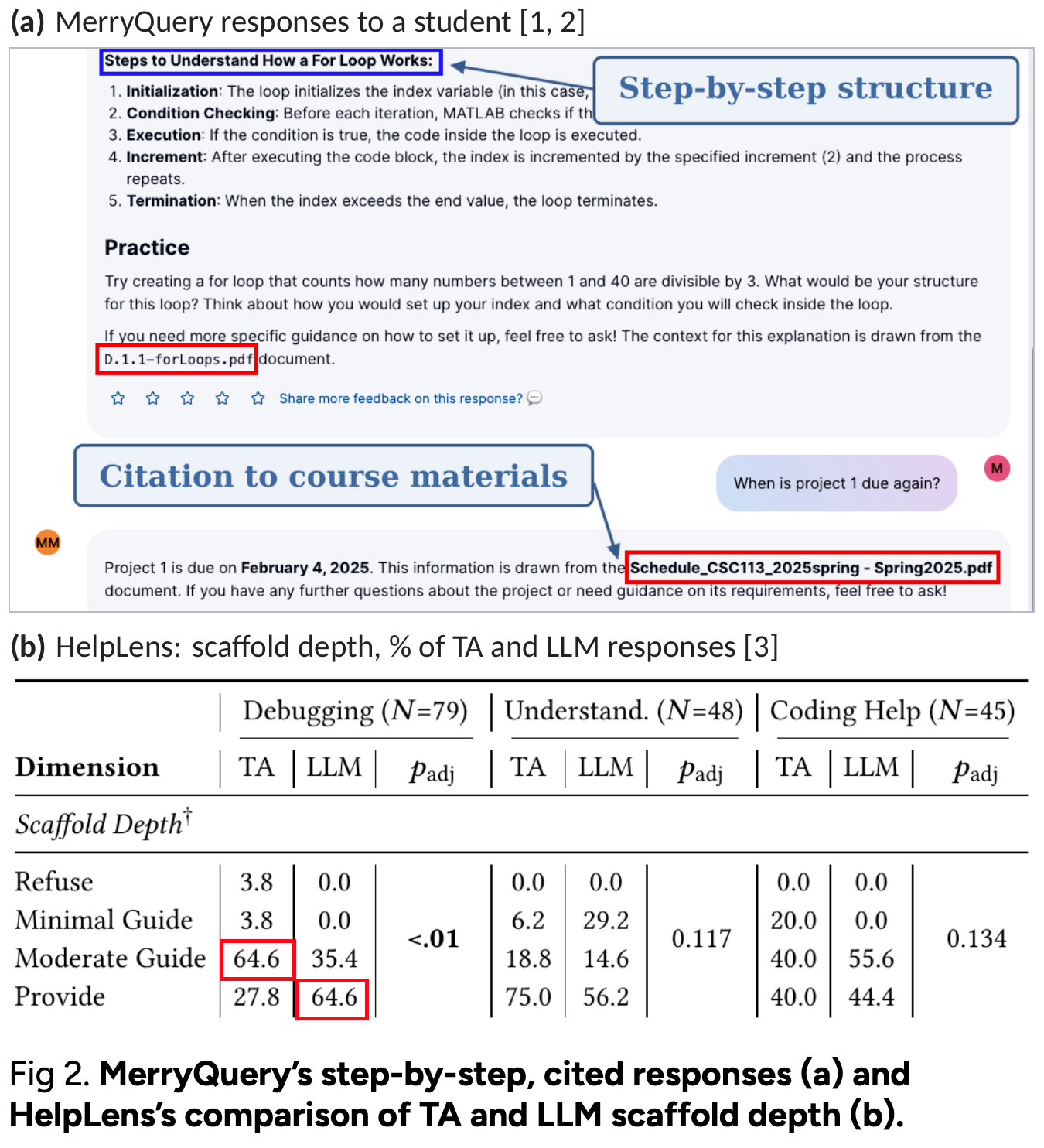
I designed and deployed MerryQuery, an educational assistant that grounds its responses in course materials, cites sources, structures explanations as steps, and gives instructors control over how much of a solution it reveals. It has supported more than 750 students across three semesters and received the AAAI 2025 Best Technical Demonstration Award.
In a 14-week classroom study, 162 consenting students generated more than 4,000 queries. Seventy-one percent reported that the assistant helped them learn, yet students ranked teaching assistants and course materials above it. These findings motivate closer study of the instructional choices behind AI help.
I developed HelpLens, an eight-dimension framework and annotated dataset comparing teaching-staff and LLM responses to 172 authentic programming questions. The model offered code more often; staff more often calibrated help to the type of question. This work characterizes assistance and informs future studies of its effects on learning.
Selected work
- MerryQuery: A Trustworthy LLM-Powered Tool Providing Personalized Support for Educators and StudentsAAAI 2025 · Best Demo
I led the design and evaluation of the classroom assistant.
- MerryQuery in the Loop: How Students Use and Perceive a GenAI-Powered AssistantSIGCSE 2026 · SRC poster
A semester-long study of students' use and perceptions of GenAI support.
- Characterizing Teaching Staff and LLM Responses to Forum Queries in Introductory ProgrammingIn preparation
HelpLens: a pedagogical framework and annotated dataset for analyzing instructional choices.
Where this work is going
I will compare evaluation-first, production-first, and balanced learning activities, using MerryQuery and HelpLens to study how assistance affects students' independent debugging, explanation, and verification skills after a delay.
GenAI in the Hands of Students, Developers, and Teachers
How do people use, judge, and shape AI in the settings where they learn and work?
In interviews with 16 early-adopter software developers, we found that LLMs supported implementation, refactoring, and debugging, while people continued to check, revise, and often discard the output. Human judgment and foundational knowledge remained central to their work.
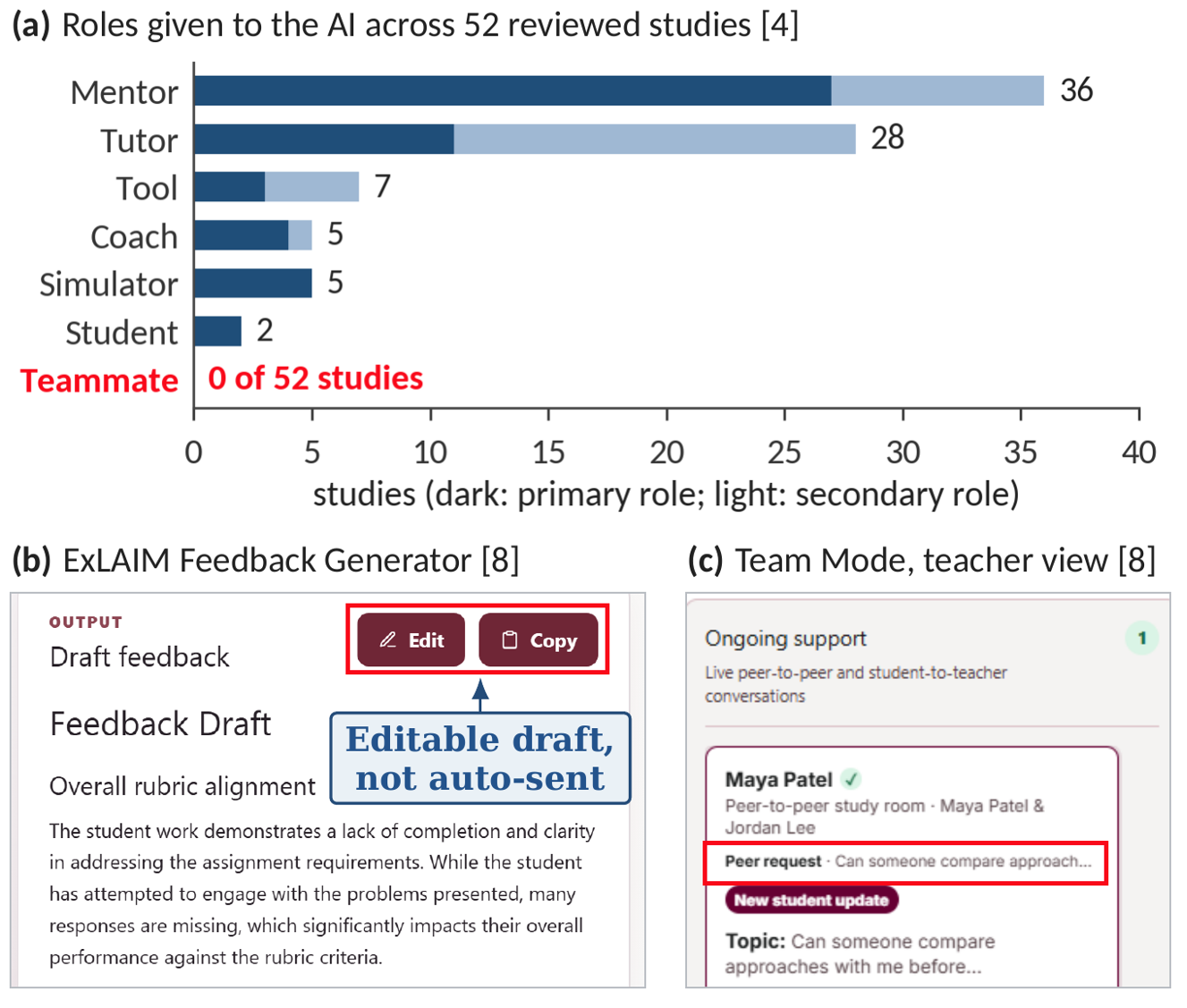
I led a systematic review of 52 studies of student-facing LLM tools in computing education. Most evaluated students' perceptions; fewer measured academic performance. None cast AI as a teammate, opening questions about how AI might support peer learning.
I lead ExLAIM, an NSF ExLENT-funded co-design program. In Summer 2026, nine K–12 teachers and seven undergraduate developers built five classroom tools on MerryQuery. Teachers asked for human checkpoints: editable drafts, review before release, and control over when AI contributes.
Selected work
- LLMs' Reshaping of People, Processes, Products, and Society in Software DevelopmentEmpirical Software Engineering · Equal contribution
A qualitative study of where developers use AI and where human expertise remains essential.
- Student-Facing LLM Tools in Computing EducationUnder review · Preprint available
A systematic review of roles, designs, evaluations, and reported impacts across 52 studies.
- Teachers and Developers Building Together: The ExLAIM Six-Week Co-Design ProgramSubmitted to CHI
I led the program and study of how teacher and developer perspectives become classroom tools.
- Human-Centered Design of LLM-Powered Educational ChatbotsAI-HCI 2026
Research with secondary teachers on the design of classroom chatbots.
Where this work is going
I will study AI-supported peer learning through Team Mode, measuring group performance alongside individual learning. Future co-design cohorts will include K–12 students and industry developers, following their ideas from proposals through sustained classroom use.
Novice Struggle and Scaffolding
Where do learners struggle, and which scaffolds help them reason, plan, and make progress?
I evaluated programming struggle and progress detectors against think-aloud protocols, screen recordings, and learners' reports. The detectors sometimes mistook copied starter blocks for progress or unusual correct strategies for struggle. Logs show behavior, but they do not fully explain a learner's reasoning.
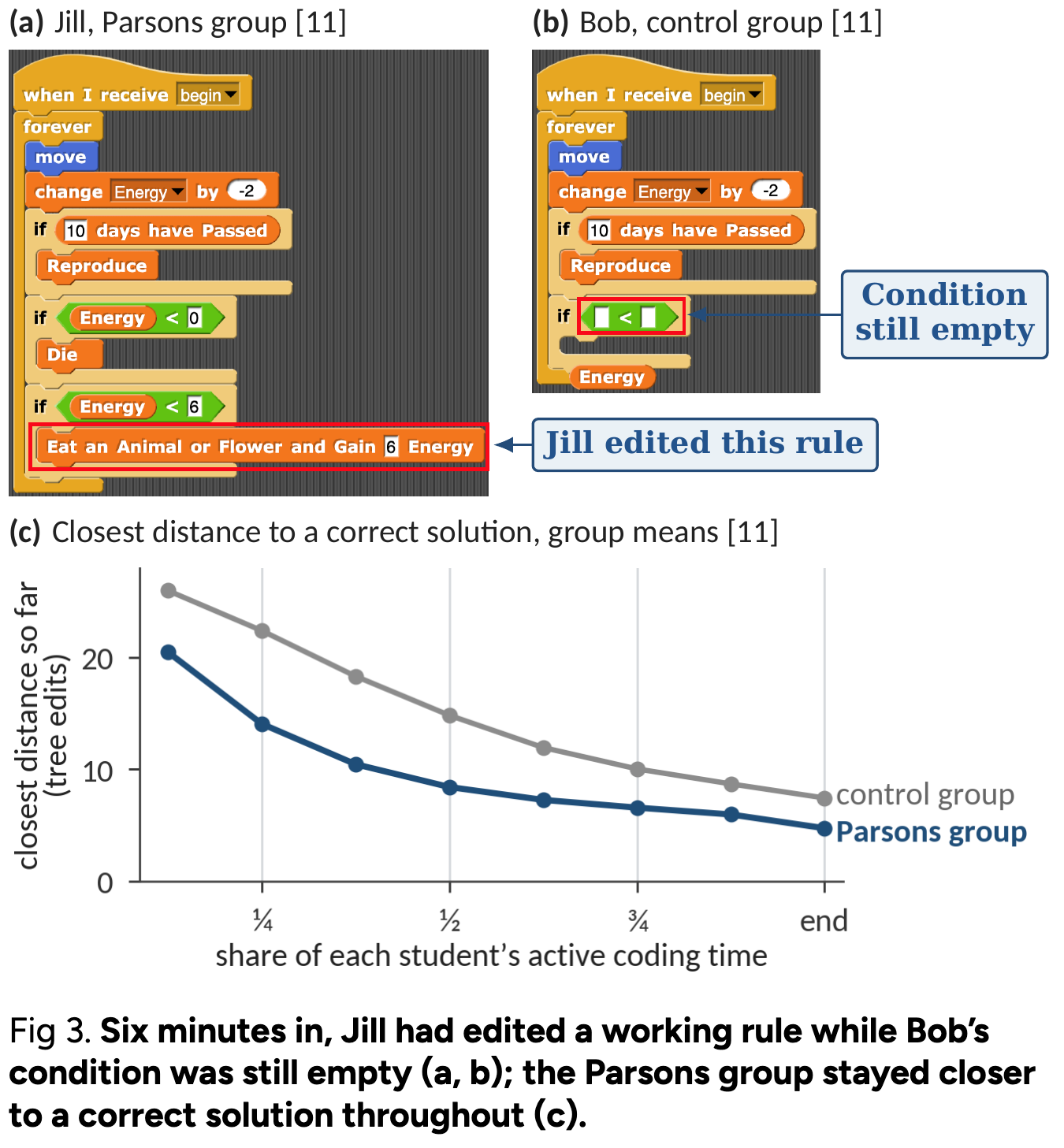
In a quasi-experiment with 199 sixth-graders, students using Parsons problems (scrambled code blocks to reorder) were scored higher on the science task, spent less time coding, ran their programs more often, and stayed closer to a correct solution. The scaffold reduced the search for blocks and left room to test and explore.
I also contributed to Jigsaw, a visual tool for decomposing and planning programming problems, recognized with the IEEE VL/HCC 2024 Best Research Paper Award.
Selected work
- Scaffolding Novices: Analyzing When and How Parsons Problems Impact Novice ProgrammingICER 2024
I studied how scaffolding changed learners' programming processes and outcomes in an integrated science assignment.
- Exploring Novices' Struggle and Progress During ProgrammingVL/HCC 2023
Validating data-driven detectors against think-aloud accounts of students' experiences.
- Jigsaw: A Visual Tool for Decomposing and Planning Programming ProblemsVL/HCC 2024 · Best Paper
A collaborative contribution to visual support for programming problem solving.
Where this work is going
I will use these methods to understand what learners can do independently after AI-supported work, and to develop learner models for peer collaboration that check behavioral traces against students' own accounts.